My tools have died twice in fifteen years. The job never did.
AI changes the speed of building, but great products still depend on human judgement.
JULY 09, 2026 • TEAM NFN
I have been shipping products for fifteen years. Long enough to watch my tools die twice.
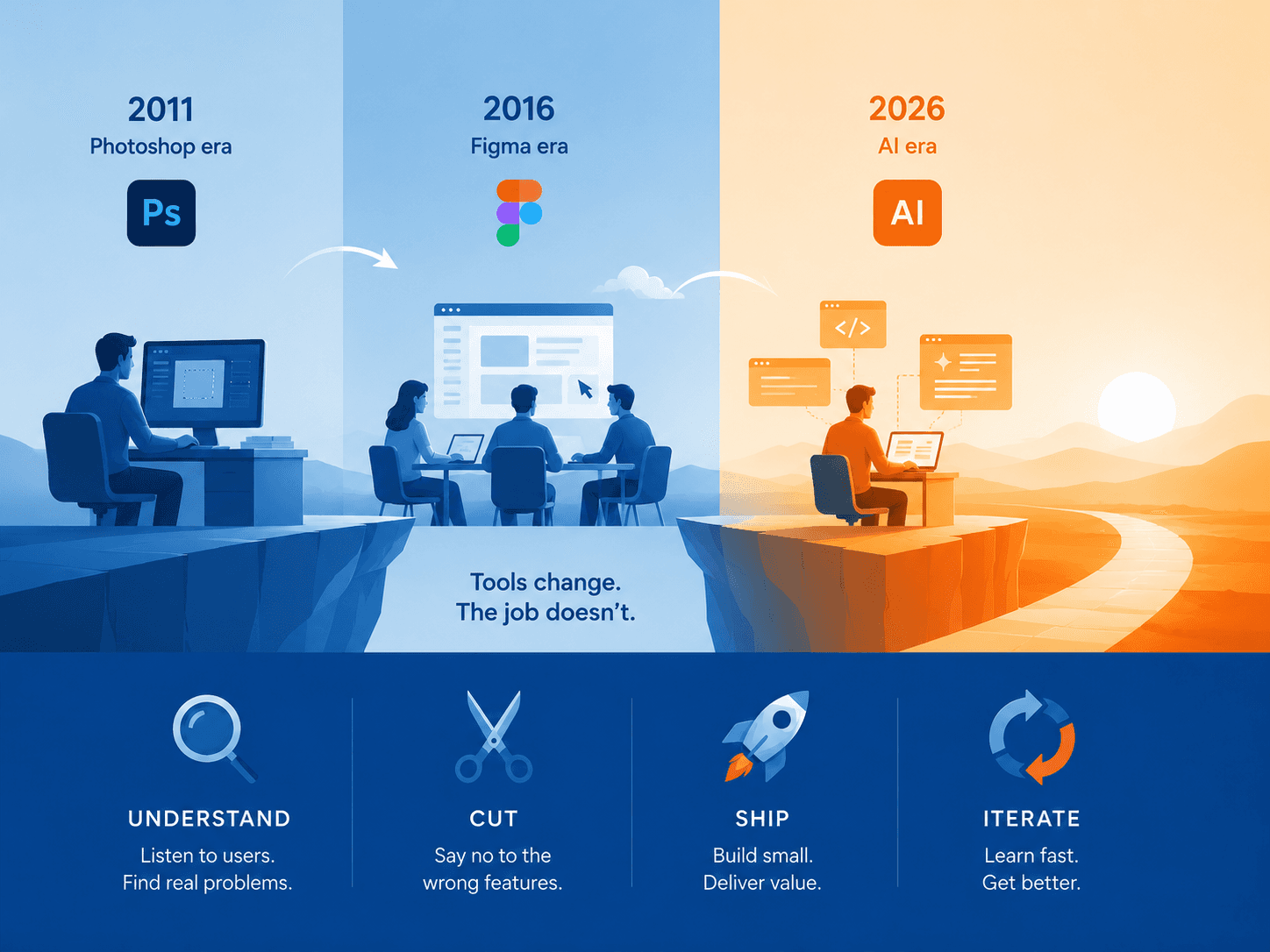
I started in Photoshop. Slicing screens into assets, exporting them one at a time, emailing files named final_v3_FINAL_approved.psd. Then Figma arrived and made all of that look silly. Design moved into the browser, the whole team worked in one file, and developer handoff stopped being a week-long ceremony. Now AI is doing to the Figma era what Figma did to the Photoshop era. Will tools like MagicPath and Claude Design - first drafts of screens, code, and copy show up in minutes instead of days.
The job is this: understand the user, cut scope, ship, iterate. That was the job in 2011. It is the job in 2026. Every tool I have ever used was just a faster or slower way of doing those four things.
No tool has ever sat in a customer call. Not Photoshop, not Figma, not any AI model. None of them heard the frustration in someone's voice while they walked through a workaround held together by spreadsheets. That signal still comes from humans listening.
Cutting scope was never a tooling problem either. It is a courage problem. The hard part of a first version is not producing features, it is saying no to the seventeen features that feel important and are not. AI makes this harder, not easier, because generating one more feature now costs almost nothing. Cheap production is a gift to disciplined teams and a trap for everyone else.
So what does AI actually change? The cost of a first draft has collapsed. We can now test three product directions in the time it used to take to mock up one. The distance between an idea on a whiteboard and a working prototype has shrunk from weeks to days. That is a real and enormous shift, and we have rebuilt our whole process around it.
And what does it leave untouched? Someone still has to decide what to build. AI will cheerfully generate a beautiful version of the wrong product. It has never met your users. It holds no opinion about what to cut. Judgement remains a fully manual process.
We call NFN Labs an AI-native studio, and I want to be precise about what that means, because the term gets abused. It does not mean the work is automated. It means we rebuilt how we work around one new fact: drafts are now cheap, and judgement is now the expensive part. So we spend the time we save where it compounds, on understanding users and making scope decisions.
If you are a founder choosing a team to build with, ask about their judgement, not their tools. The tools will change again within five years. I would bet the studio on it, because I have already watched it happen twice. The job will still be the same four verbs: understand, cut, ship, iterate.
If you are building a product - we would love to bring it to life! Get in touch?
Tags: AI Product Design • Figma • Claude AI • Product Design


