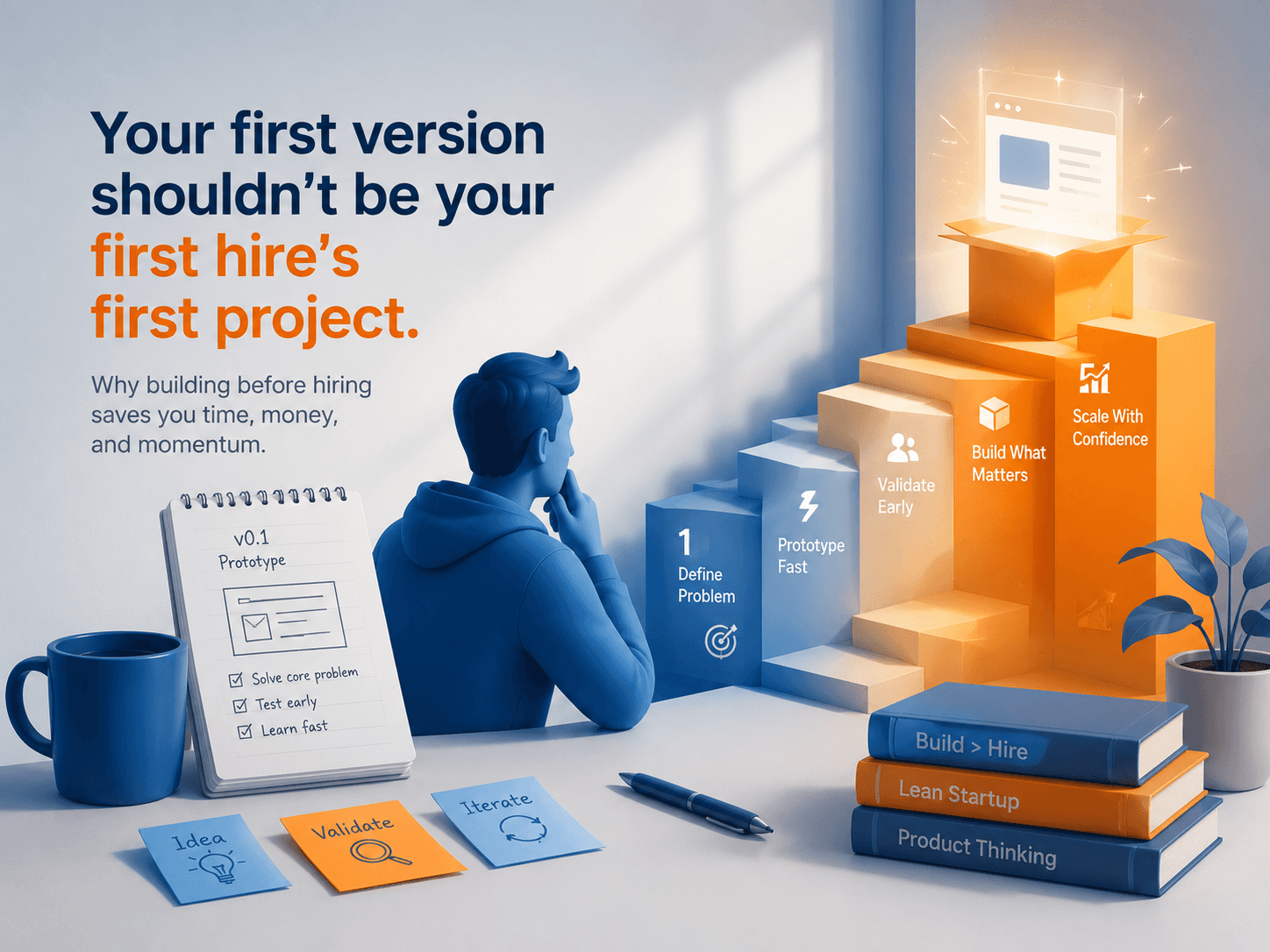
Your first version shouldn't be your first hire's first project
Why founders should validate before building an in-house team.
JULY 06, 2026 • TEAM NFN
There's a decision every founder makes early, usually without realizing how much it costs: who builds version one.
The instinct is to hire. Get a couple of engineers, maybe a designer, put them in a room, and build the thing. It feels like the responsible move — you're building a company, companies have teams, so hire the team.
Here's the part nobody puts on the whiteboard. Before your first three hires ship a single screen, you've spent months. Writing job descriptions. Screening. Interviewing. Waiting out notice periods. Then onboarding, setting up the repo, arguing about the stack, and slowly figuring out how they work together. Realistically that's four to six months and a good chunk of your seed round, and at the end of it you don't have a product. You have a team that's almost ready to start building the product.'
For a first version, that math doesn't work.
The thing about first versions
A first version is not a smaller version of a big product. It's a different job entirely. You're not scaling anything yet - you're trying to find out if the thing is worth scaling. That means the whole game is speed and judgement: what to build, what to skip, where to cut a corner cleanly and where cutting one will bite you in six months.
That judgement doesn't come from talent. It comes from reps. From having shipped enough first versions to know, without a meeting, which decisions actually matter this week and which ones are you procrastinating with architecture diagrams.
Your first three hires are probably excellent. But if this is their first-ever v1 together, they're learning that judgement on your time and your money. You're paying tuition for a lesson we've already paid for a hundred times over.
What that looks like in practice
Take SaaS22 - now JazzHQ. Krish came to us wanting a multi-role B2B platform that helps businesses discover, compare, implement, and optimise SaaS. Vendor recommendations, partner workflows, the whole lifecycle across web and mobile. That is not a weekend project. Built in-house from a standing start, you're looking at the hiring cycle plus the build.
We didn't need the ramp-up. There was no team to assemble, no stack debate, no learning-on-the-job. We've built enough of these that we knew the shape of the problem before the first call ended, so the time went into the product instead of the setup around it.
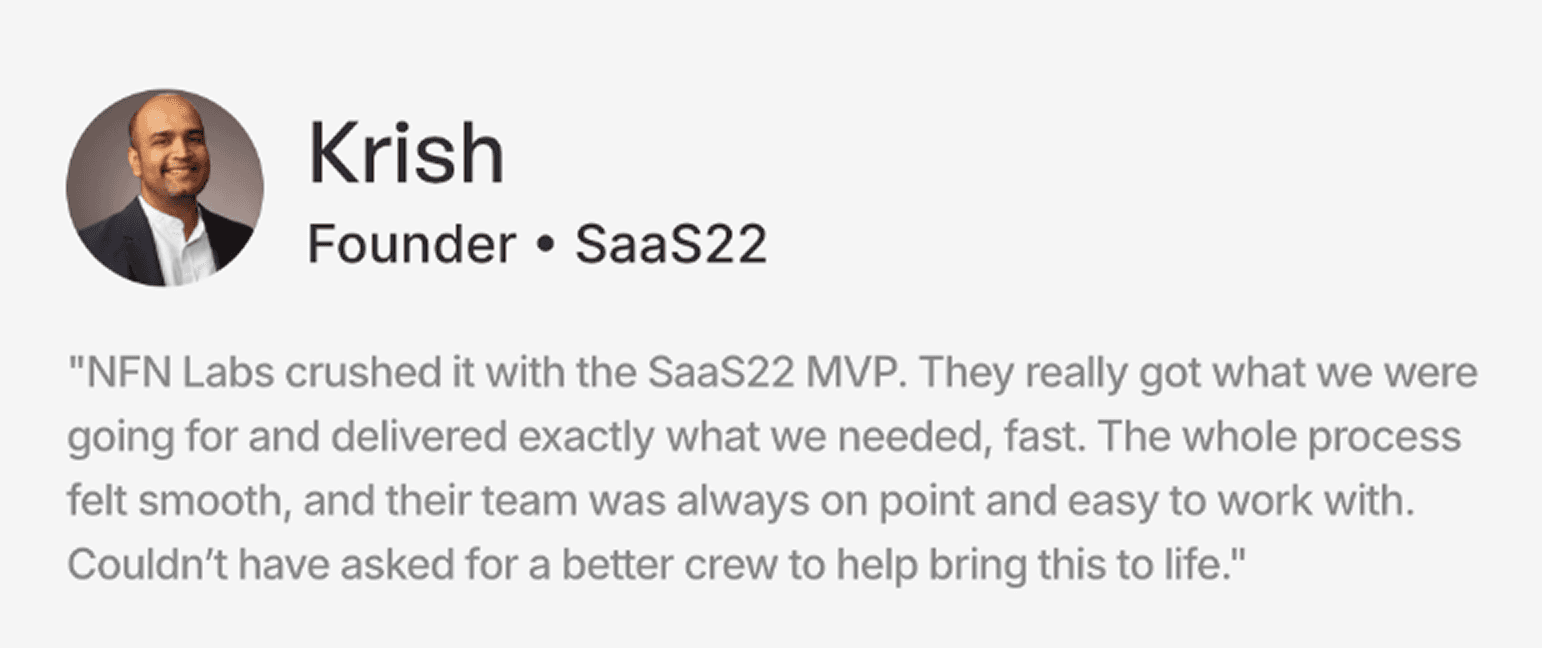
Krish's words, not ours: "NFN Labs crushed it with the SaaS22 MVP. They really got what we were going for and delivered exactly what we needed, fast. The whole process felt smooth, and their team was always on point and easy to work with. Couldn't have asked for a better crew to help bring this to life."
View all customer reviews
The "fast" and the "got what we were going for" are the same thing. When you've shipped a hundred first versions, understanding what a founder actually needs is the speed. You're not decoding the brief for the first time.
"But I'll need the team eventually"
You will, and you should build it - once you know what you're building. That's the point.
Hire in-house when you have traction and a product that's earned its team. Building the org around a proven product is a completely different, much safer bet than betting your first two quarters on three people finding their rhythm while the runway ticks down. Get the first version live, put it in front of real users, learn what's true. Then hire against something real instead of a hunch.
We've shipped 100+ products across SaaS, D2C, healthcare, and logistics, and the founders who move fastest almost never start by hiring. They start by shipping, then hire once the product tells them who to hire.
That's the whole idea behind how we work. You bring the vision and the business. We bring the design, engineering, and the judgement that only comes from having done this a hundred times. You get a live product in weeks, not a team in a few months.
If you're sitting on a first version and weighing whether to hire for it or ship it - that's the conversation we have every week. Let's team up.


