The Ultimate SaaS Tech Stack for Seed to Series A Startups
How to build a future-ready SaaS architecture without overengineering early
FEB 16, 2026 • TEAM NFN
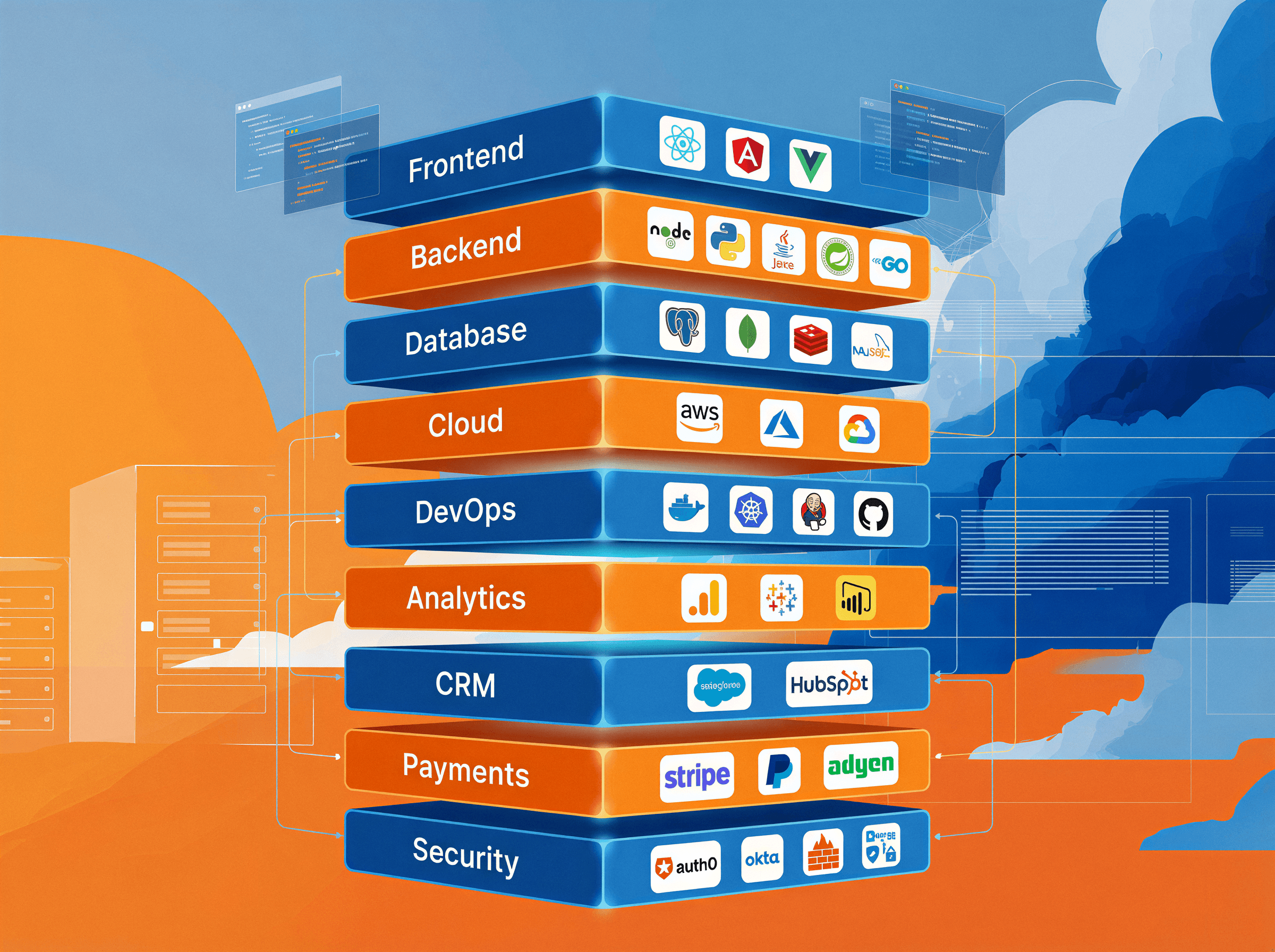
The right technology stack is vital for SaaS startups, especially when moving from MVP to early scale. In 2026, an optimal SaaS tech stack balances quick development, low cost, and the ability to grow. It typically spans front-end and back-end frameworks, databases, cloud hosting, DevOps/CI-CD, analytics, CRM/support tools, email/payment systems, and security layers. The choices you make now affect how fast you can iterate, how you collect data, and whether you can serve hundreds or thousands of customers without rework. For example, Signal Intent (a calculators platform) uses Vue.js for the UI, Node.js on the backend, PostgreSQL for data, and AWS infrastructure to handle real-time analytics. Similarly, Notion’s stack includes React/Redux (front-end), Node.js/Express, PostgreSQL/Redis, and AWS/Kubernetes for scalable hosting.
Front-end: Modern UI frameworks like React, Vue.js, or Angular power responsive interfaces. React (backed by Meta) and Vue are popular for their component models and large communities.
Back-end: Server-side platforms such as Node.js, Python (with frameworks like Django/Flask), or Ruby on Rails handle business logic. Node.js is widely used (as in Notion and Spotify) for scalable APIs.
Database: Relational DBs (PostgreSQL, MySQL) and NoSQL options (MongoDB, Cassandra) store your data. PostgreSQL is a common choice for its robustness (used by Signal Intent and Notion).
Cloud Infrastructure: Hosting on AWS, Google Cloud, or Azure is standard. These provide on-demand VMs, managed databases, and services for reliability. Early-stage teams might start with cloud free tiers or platforms like Heroku/DigitalOcean for simplicity, then graduate to full AWS/GCP clusters as users grow.
DevOps/CI-CD: Automated deployment and testing are key. Tools like GitHub Actions, GitLab CI, Jenkins, or CircleCI build and deploy code. Containerization with Docker and orchestration (e.g. Kubernetes) simplify scaling.
Analytics & Monitoring: Embedded usage tracking and error logging help product teams. Common tools include Google Analytics (free website metrics), Mixpanel/Amplitude (product analytics), Sentry/Datadog/New Relic (error and performance monitoring).
CRM & Marketing: To manage leads and customers, many startups use HubSpot CRM (offers a free tier) or Zoho CRM (popular in India) for basic CRM, and upgrade to Salesforce as they scale. Marketing automation tools like Mailchimp or HubSpot Marketing Hub help with email campaigns. A 2026 comparison ranks HubSpot CRM highly for startups.
Customer Support: SaaS teams often start with Zendesk or Freshdesk (both have startup-friendly tiers) for ticketing and chat, or Intercom/Drift for in-app messaging. These tools handle user feedback and support efficiently.
Email & Notifications: Transactional and marketing emails are powered by services like SendGrid, Amazon SES, or Mailchimp. These services offer pay-as-you-go plans suitable for early startups.
Payments & Billing: For subscription billing, Stripe is widely used globally (easy API, multi-currency support). In India, startups often use Razorpay or Paytm Payment Gateway, which natively support local methods like UPI and handle RBI compliance. (Stripe also has India support but local PSPs simplify UPI integration.)
Security & Auth: SaaS products must secure user data and logins. Authentication services like Auth0 or Firebase Auth can speed up sign-in integration. Tools or frameworks enforcing encryption, secure storage, and vulnerability scanning are also part of the stack.
Each component should match your current needs. For a new MVP, lean solutions minimize costs, while for a Series A startup, robust platforms prepare you for growth.
SaaS Tech Stack 2026: Trends and Best Practices
By 2026, cloud-native architectures and modular, API-driven designs dominate SaaS. Experts recommend choosing a stack aligned to your product’s needs (not chasing trends). For instance, Brights suggests that data-intensive SaaS (analytics, BI apps) pair React+TypeScript (front-end), Node.js/Python (back-end), and a combo like PostgreSQL/Snowflake + Elasticsearch on AWS/GCP. This empowers fast querying of large datasets. API-first SaaS (developer tools, headless services) often use React/Vue, Node.js/Express or FastAPI (Python), and PostgreSQL/MongoDB on AWS/GCP, facilitating microservices and integrations.
A common pattern in 2026 is the MERN (Mongo, Express, React, Node) or MEVN (Vue) stack for full-JavaScript simplicity. However, serverless architectures are also rising for microservices. For example, a micro-SaaS (a very lean product) might use AWS Lambda, DynamoDB, and S3, trading some control for automatic scaling and low ops overhead. The key is to think of your stack as layered: frontend, backend, data, infrastructure, integrations, and security, and pick each layer to fit your scenario.
“The thing with picking the best stack… you have to be sure how well it will serve you in the future. A well-matched stack can speed up the development process, reduce maintenance overhead, and prepare your product for scaling.”
– Bohdan K., Business Analyst at Brights
Affordable vs. Scalable Options
Seed-stage teams usually start lean. For example
:
Cloud / Hosting: Start with AWS/GCP free tier, DigitalOcean, or Heroku’s hobby plans. These require minimal setup. As you scale, move to Kubernetes on AWS/EKS, GKE, or Azure AKS for robust orchestration.
Databases: An early project might use a single PostgreSQL instance (on Heroku or DigitalOcean) or even SQLite for the simplest cases. For growth, plan for managed DB clusters (AWS RDS/Aurora, Google Cloud SQL) or distributed NoSQL (e.g. MongoDB Atlas).
Backend Frameworks: Use a high-productivity framework like Laravel (PHP) + Vue or Rails for fast MVP development. These come with many built-in features. Later, you might shift to microservices in Node.js/Python or add a statically-typed layer (TypeScript, etc) for safety.
DevOps: Begin with free CI/CD such as GitHub Actions or GitLab CI. As your deployment complexity grows, consider Jenkins or commercial tools (CircleCI, TravisCI) with advanced workflows. Containers (Docker) can be adopted early; cluster management (Kubernetes) can wait until you need true horizontal scaling.
Analytics: Use Google Analytics (free) for basic user metrics; consider hotjar or FullStory for early UX feedback. When the user base expands, invest in product analytics like Mixpanel or Amplitude for funnel analysis, A/B tests, and retention tracking.
CRM: HubSpot CRM and Zoho CRM have free tiers for small teams. They cover contacts, pipelines, and email integration. When you have a dedicated sales team and budget, upgrade to Salesforce or paid HubSpot Sales Hub.
Support: Start with Freshdesk (free tier) or email-based support. As customers grow, move to Zendesk Suite or Intercom, which offer rich ticketing, chatbots, and knowledge bases.
Email Marketing: Mailchimp or MailerLite have free plans for small lists; for larger scale, migrate to dedicated platforms (SendGrid Marketing, Klaviyo, HubSpot Marketing).
Payments: Initially, Stripe (no monthly fee, just per-transaction) is ideal. To minimize failed payments in India, adding a local PSP like Razorpay early can boost subscription conversion. Later, integrate advanced billing platforms (Chargebee, Recurly) as you manage complex subscription plans.
Component | Early-Stage (Budget-Friendly) | Growing-Stage (Scalable) |
Cloud Hosting | Heroku, DigitalOcean, Free AWS Tier | AWS / GCP / Azure with Kubernetes, Multi-region setup |
Backend Framework | Laravel + Vue, Ruby on Rails, Node.js (Express) | Microservices using Node.js, Python (Django), or Go |
Database | Single PostgreSQL / MySQL, SQLite | Managed RDS / Aurora, Cloud SQL, MongoDB Atlas |
CI/CD | GitHub Actions (Free), GitLab CI (Free) | Jenkins, Self-hosted GitLab CI, CircleCI |
Analytics | Google Analytics (Free), Hotjar | Mixpanel, Amplitude, Datadog |
CRM | HubSpot CRM (Free), Zoho CRM | Salesforce, HubSpot Enterprise |
Support / Chat | Freshdesk (Free), Email Support | Zendesk Suite, Intercom |
Payments | Stripe / PayPal (Per-transaction) | Stripe + Razorpay (India) + Chargebee |
Team Chat | Slack (Free), Discord | Slack (Paid), Microsoft Teams |
Real-World Examples
Looking at successful SaaS companies confirms these choices. For example, Signal Intent (a SaaS calculator platform) chose Vue.js (frontend), Node.js (backend), PostgreSQL (database), and AWS (infrastructure). This setup was designed for flexibility and cost-efficiency for small teams. Notion, the workspace SaaS, uses React/Redux, Node.js/Express, PostgreSQL/Redis, and AWS/Docker/Kubernetes, illustrating a common modern stack. (Larger tech firms like Spotify use JVM languages, Kafka, Cassandra, etc, but startups often stick with JavaScript/Node and cloud services for speed.)
India SaaS Startup Stack: Local Considerations
Indian SaaS startups may choose tools that handle local market needs. For instance, payment infrastructure often includes Indian gateways: Razorpay, Instamojo or Paytm, which support UPI, RuPay, and local wallets out of the box. Razorpay in particular is built as “India’s full-stack payment solution for global SaaS” – it ensures 100% coverage of Indian payment methods (UPI, cards, etc.) and automates recurring billing compliance. Thus, a SaaS startup selling in India often pairs Stripe (global) with Razorpay (India).
Collaboration and CRM tools in India follow global trends. Notably, 70% of Indian unicorns use Slack, and Slack is India’s 3rd largest market by user count. This shows Indian SaaS teams rely on the same modern productivity tools (Slack, Zoom, Google Workspace) as elsewhere. However, many also adopt Zoho CRM or Freshworks (Freshdesk/Freshsales) – local companies from Chennai with generous free tiers – because they know the local market and pricing. Data residency is less of a concern for SaaS (multi-tenant by design) than it is for other sectors, but most providers (AWS, Azure) have India regions now.
Regionally, note that India’s SaaS ecosystem is not just in Bangalore/Mumbai: over 50% of Indian tech startups are now from Tier II/III cities. This broadens the talent pool and customer base. So designing for low-bandwidth (e.g. PWA, efficient mobile UI) and UPI payments can make your SaaS more India-friendly.
“For startups and MVPs, Esferasoft recommends a leaner, cost-effective stack: Vue.js + Laravel + MySQL + DigitalOcean. This prioritizes speed, simplicity, and predictable costs, ideal for validating a product before upgrading infrastructure as the business matures.”
Key Takeaways and Next Steps
Choosing your SaaS tech stack is both a technical and a business decision. For seed-stage startups, prioritize speed to market and low cost by using frameworks and services with free tiers and large talent pools (e.g., Laravel/Vue, React/Node, Heroku, AWS Free Tier). As you approach Series A, invest in more scalable systems (managed databases, Kubernetes, enterprise CRM, robust monitoring). Always align your stack to where you plan to be in 6–12 months, not just day one.
Finally, remember to incorporate SEO and growth from day one: use analytics to track key SaaS metrics (MRR, churn), use SEO-friendly tech (fast hosting, mobile-friendly UI), and ensure your stack can integrate marketing tools.
Ready to build your SaaS? Stay informed on the latest tools and strategies by subscribing to our newsletter. Or contact us for a free demo on how to leverage these technologies in your startup’s journey.
Tags: Tech Architecture • Cloud-Native • SaaS Engineering • MVP Stack


